To meet singles after 50: join community groups, take a class, volunteer, try one dating app, attend local events, explore travel groups for singles, and ask friends for introductions. Use more than one method — the people you meet through hobbies and community are often better matches than algorithm-selected strangers.
The landscape for meeting people has changed since you were last single. Some of it is easier now — there are more tools, more groups, more ways to connect. Some of it is harder — fewer people meet through work or mutual friends than they used to, and the sheer number of options can feel paralyzing.
Here is what has not changed: people still connect over shared interests, repeated exposure, and genuine conversation. If you are wondering where to meet singles over 50, the logistics of finding those opportunities is what this guide covers. Not whether you are emotionally ready — if you need to think through that first, Am I Ready to Date Again After 50? is the right starting point. And not what shape the relationship takes — if you already know you want partnership without marriage, Dating Without Remarrying covers that. If you want a committed relationship while keeping your own home, Living Apart Together After 50 explores that model. And not the full dating journey from first thought to first relationship — that is what How to Start Dating Again After 50 covers.
This is the logistics article. Where do you actually find people? Let’s get specific.
If you are returning to dating after a divorce specifically, Dating After Divorce at 50 addresses the unique challenges of that transition. If you are navigating dating after losing a spouse, Dating After Widowhood addresses that journey with care.
Use More Than One Path
The single most effective strategy for meeting people after 50 is not finding the perfect method. It is using more than one.
When you rely entirely on dating apps, a dry spell feels like failure. When you rely entirely on one social group, the pressure on that group becomes uncomfortable. But when you combine two or three channels — an app plus a weekly class plus telling a few friends you are open to introductions — no single method carries all the weight.
Think of it as creating more surface area for natural conversation, not turning every room into a dating room. You are not scanning every yoga class for prospects. You are building a life with more social contact, and letting connection happen within that life.
The mix that works best for most people over 50: one online tool used moderately, one recurring in-person activity, and one social circle that knows you are open. That is enough. You do not need to be everywhere at once.
Online Dating: A Brief Overview
Dating apps work for some people over 50. They do not work for everyone. They are one tool in your approach, not the entire strategy.
The honest pros: apps give you access to a large pool of people who are actively looking for connection. You can filter by age, location, and interests. You can browse at midnight in pajamas. For people in rural areas or with limited social networks, apps may be the most efficient way to find others who are also looking.
The honest cons: apps can feel overwhelming, superficial, and discouraging. Ghosting is common. Scam accounts exist on every platform. Learn to spot them early with our guide to Romance Scam Warning Signs. The endless swiping can become its own time sink without producing real connections. And many people over 50 report that the experience feels unnatural — like shopping for a person rather than meeting one.
Major platforms worth knowing about: Bumble, Hinge, OurTime, SilverSingles, and Match all have significant user bases for people over 50. Each has a different feel. Rather than reviewing them in depth here, the more useful advice is this: pick one, give it a genuine try for 30 days, and then decide if it is working for you.
Dating app tips for over 50: Use recent photos that actually look like you. Complete your profile fully — half-empty profiles signal low effort. Be specific about what you enjoy and what you are looking for, while keeping private details out of public view; How to Make a Dating Profile After 50 Without Oversharing covers that balance in more detail. Do not swipe endlessly; set a 15-minute timer and stop when it rings. When you are ready to write that first message, First Message Examples for Dating After 50 walks through what to say and what to avoid. And read Online Dating Safety After 50 before you share personal information with anyone you have not met face to face. For common pitfalls to avoid when re-entering the dating world, see Dating After Divorce Mistakes.
Apps are a starting point for some people and a supplement for others. They are not a requirement.
How to Meet People Without Dating Apps
This is where most competing guides fall short. They mention “try a hobby” and move on. But offline methods deserve the deepest attention because the connections formed through shared activities and repeated exposure tend to be stronger, more natural, and more comfortable than those formed through algorithm matching.
Here are ten specific methods, each with a concrete action step.
1. Community classes. Art workshops, cooking courses, language classes, and pottery studios put you in a room with the same people for weeks at a time. That repeated exposure is the single strongest predictor of connection — you do not need to make a first impression because you get many impressions over time. Action step: check your local community college continuing education catalog this week. Pick one class that genuinely interests you and register before you talk yourself out of it.
2. Volunteering with a regular schedule. One-off volunteer days are fine for the world but weak for meeting people. What works is a recurring commitment: every Tuesday at the food bank, every Saturday at the habitat build, every Thursday shelving books at the library. The regularity means you build relationships with the same team. Action step: contact one local organization and ask about weekly volunteer shifts, not one-time events.
3. Faith communities and spiritual groups. Even if you are not traditionally religious, many faith communities welcome participants who are there for the community rather than the doctrine. Unitarian Universalist congregations, meditation groups, and interfaith discussion circles all create regular social contact in a values-aligned setting. Action step: attend one service or gathering as a visitor. Most communities have a newcomers welcome process that makes the first visit low-pressure.
4. Alumni and reunion events. Your college, professional association, or even high school alumni network likely hosts events — reunions, lectures, mixers, mentoring programs. These come with built-in common ground: shared history, shared references, shared geography. Action step: search for your alma mater’s local alumni chapter or check LinkedIn for alumni groups in your area.
5. Dog parks and walking groups. If you have a dog, you already have a conversation starter that shows up every single day. Dog parks create repeated, low-pressure social contact without any formal structure. Walking groups — with or without dogs — offer the same benefit with more consistency. Action step: visit the same dog park or join the same walking route at the same time for two weeks straight. You will start recognizing faces by day four.
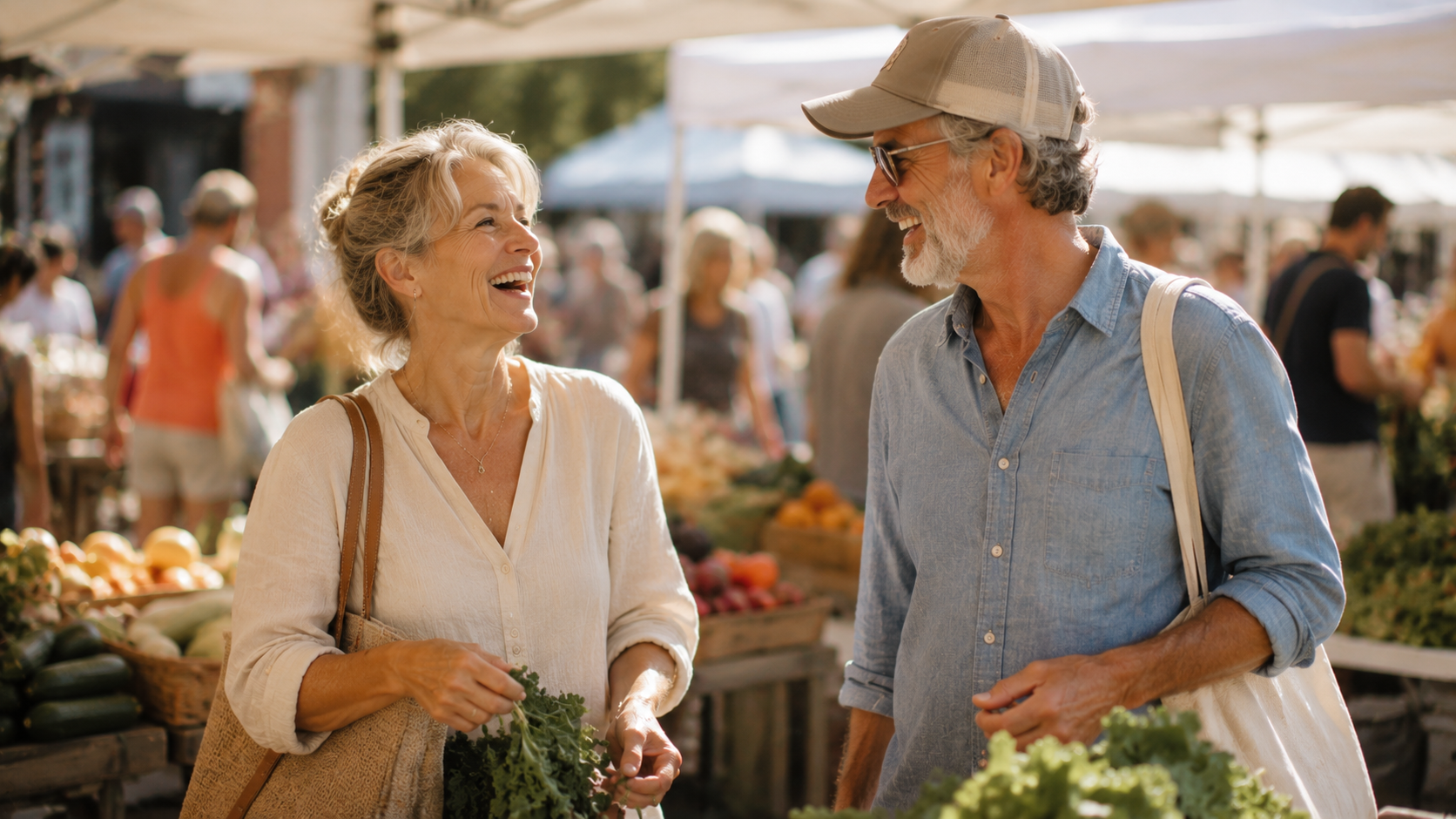
6. Farmers markets and regular venues. Becoming a regular somewhere is underrated. When you go to the same farmers market, coffee shop, or bookstore at the same time each week, you become a familiar face. Familiar faces get talked to. Action step: pick one weekly venue — a Saturday market, a Sunday coffee shop — and commit to going at the same time for a month.
7. Hobby groups. Photography clubs, gardening societies, wine tasting groups, birdwatching walks, book clubs, cycling groups, hiking clubs. The activity matters less than the structure: a recurring group of people doing something together. Action step: search Meetup.com for your zip code and your top three hobbies. Join one group and attend at least three meetings before deciding if it fits.
8. Professional networking and encore career groups. If you are still working or exploring a second act, professional groups create social contact with a purpose. Industry meetups, entrepreneurship groups, Toastmasters, and encore career workshops all attract engaged, interesting people. Action step: attend one professional or career-interest event this month, even if you are retired. The energy of people pursuing something new is contagious.
9. Neighborhood events and block parties. Your immediate community often has more social infrastructure than you realize: block parties, neighborhood clean-up days, community garden workdays, HOA social events, and local festival volunteer crews. These are low-commitment, low-pressure, and geographically convenient. Action step: check Nextdoor or your neighborhood association for the next community event and show up, even briefly.
10. Asking friends for introductions. This is the most underused method. Many people over 50 have friends who know other single people but have never been explicitly told “I am open to meeting someone.” The ask does not need to be dramatic. “If you know anyone who might enjoy grabbing coffee, I would be open to that” is enough. Action step: tell two friends this week, in plain language, that you are open to being introduced to people. You might be surprised how quickly they think of someone.
| Method | Effort | Cost | Introvert-Friendly |
|---|---|---|---|
| Community classes | Medium | Low-Medium | Yes |
| Volunteering | Medium | Free | Yes |
| Faith communities | Low | Free | Moderate |
| Alumni events | Low | Free-Low | Moderate |
| Dog parks / walking | Low | Free | Yes |
| Farmers markets / regulars | Low | Free | Yes |
| Hobby groups | Medium | Low | Yes |
| Professional networking | Medium | Free-Low | Moderate |
| Neighborhood events | Low | Free | Moderate |
| Asking friends | Low | Free | Yes |
Social Groups and Community Organizations
Finding the right group is often simpler than people expect. Here is where to look:
Meetup.com remains the largest platform for interest-based groups. Search by your location and filter for 50-plus or “midlife” groups. Many cities have dedicated meetup groups for singles over 50 — hiking groups, dinner groups, game nights, and cultural outings.
Local community centers run programs specifically for older adults: fitness classes, art workshops, discussion groups, and social clubs. These are often free or very low-cost.
Libraries host book clubs, lecture series, writing groups, and community conversations. They attract thoughtful, curious people.
YMCA and YWCA programs offer fitness classes, swim groups, and social activities with a built-in community feel.
Nextdoor can surface hyperlocal groups and events you would never find otherwise — walking clubs, gardening exchanges, coffee meetups within your own neighborhood.
Faith communities — as mentioned above — offer built-in belonging for people who are comfortable in that setting.
The advantage of recurring groups over one-time events is significant: you see the same people weekly. Familiarity builds comfort, and comfort builds connection. You do not need to make an impression on day one. You just need to keep showing up.
Travel Groups for Singles Over 50
Travel creates connection in a way that everyday life rarely does. When you spend multiple days with the same group in a novel environment, the bonding accelerates. Shared experiences — navigating a foreign city, trying unfamiliar food, marveling at the same view — build intimacy faster than weekly one-hour meetings.
Types of travel groups worth exploring:
- Organized educational tours like Road Scholar (formerly Elderhostel) combine learning with social travel in age-appropriate groups
- Solo traveler designated trips from companies like Overseas Adventure Travel, Intrepid, or G Adventures specifically welcome single travelers and often eliminate single supplements
- Cruise singles meetups — many cruise lines host mixers and assign single-friendly dinner seating
- Adventure and cultural tours focused on hiking, photography, cooking, or wine that attract active, curious travelers
Practical tip: search specifically for trips labeled “solo traveler” or “singles welcome.” These are designed so you will not feel like the odd one out among couples. The extended time together — days rather than hours — means you actually get to know people beyond surface-level pleasantries.
How to Find Singles Events Near You
Finding events is a skill, not luck. If you have ever searched singles events near me over 50 and felt overwhelmed by generic results, here is a better approach:
Search these platforms: Meetup (search “singles over 50” plus your city), Eventbrite (search “singles” or “speed dating 50+”), and Facebook Events (search “singles mixer” in your area). Check your local newspaper’s weekend events section. Visit your community center and look at the physical bulletin board — many events for older adults are still advertised on paper rather than online.
Types of events to look for: Speed dating nights for over 50, singles mixers at wine bars or restaurants, social dance nights (swing, ballroom, salsa — you do not need a partner to attend), cooking classes marketed to singles, wine or whiskey tastings, and trivia nights.
Manage your expectations wisely. Not every event leads to a romantic connection, and that is completely fine. Each event you attend builds your social confidence, expands your circle, and makes the next event easier. If you attend five events and make one new friend — not a romantic connection, just a friend — that friend may introduce you to someone six months from now. The network effect is real.
If an event feels uncomfortable, you can leave. There is no minimum attendance requirement for your own life.
Meeting People After Retirement
Figuring out how to socialize after 50 — especially after retirement removes your built-in social structure — is a challenge nearly everyone faces.
When you retire, you lose more than a paycheck. You lose daily contact with colleagues, lunch conversations, office friendships, and the passive exposure to new people that a workplace provides.
Retirement creates a paradox: you finally have the time to meet people, but you have lost the place where meeting people happened naturally. This is not a personal failing. It is a structural reality that nearly every retired person faces.
The solution is to build new recurring social anchors that replace what the workplace provided:
- Part-time work in a social setting — a bookstore, garden center, museum, or community organization. The income may not matter. The human contact does.
- Community college courses — audit a history class, take a ceramics workshop, learn a language. These provide weekly structure and repeated social contact.
- A regular gym or pool schedule — going at the same time builds a community of familiar faces faster than you expect.
- Becoming a regular somewhere — the coffee shop at 9am, the library on Tuesdays, the park bench with a book on Thursdays. Routine creates recognition, and recognition creates conversation.
The adjustment takes time. Give yourself a few months of showing up before judging whether it is working.
Meeting People as an Introvert After 50
Introversion is not a barrier to meeting people. It is information about which methods will work best for you. For introverts meeting people after 50, the key is choosing structured environments that match your energy rather than fighting against it.
If large mixers and speed dating events sound exhausting, they probably are — for you. That does not mean you cannot meet people. It means you need to choose your environments more carefully.
What works for introverts:
- Structured activities over unstructured social events. A cooking class with a clear task is easier than a cocktail party with no agenda.
- Small groups over large crowds. A book club of eight people is more manageable than a mixer of sixty.
- One-on-one over group dating events. A coffee with someone you met through a friend beats a speed dating round.
- Activities with side-by-side conversation. Walking groups, gardening clubs, and art classes allow conversation without sustained eye contact, which many introverts find draining.
- Online messaging as a warmup. Starting a conversation digitally before meeting in person can help introverts feel more prepared and less ambushed by social pressure.
Specific suggestions: book clubs, cooking classes with a partner station, volunteer roles where you work alongside one other person, nature walks, and photography groups where you walk together but focus on the activity rather than forced interaction.
You do not need to become extroverted. You need to find the environments where your natural way of connecting is an asset, not a liability.
If You Have Been Single for Years: Starting from Zero
If you have been wondering how to meet someone after being single for years — five, ten, or twenty years — the prospect can feel enormous. Not just logistically difficult — emotionally unfamiliar. You may feel like you have forgotten how to do this, or like the world has moved on without you.
Here is what is true: the gap between where you are and where you want to be is smaller than it feels. You have decades of conversational experience. You know how to be kind, how to listen, how to ask a question. Those are the skills that matter. The rest is just context.
Start with social confidence rather than dating. The goal is not to find a partner next month. The goal is to rebuild the muscle of connecting with strangers in a way that feels natural rather than forced.
Specific first steps:
- Smile at one stranger daily. Not as a romantic signal — as practice being open.
- Have one brief conversation with someone new per week. At the grocery store, the library, a community event. Just practice.
- Join one recurring group activity where you will see the same faces repeatedly.
Once those feel normal — and they will, faster than you expect — you can start being intentional about meeting people in a romantic context. But the foundation is social comfort, and that comes from repetition, not from courage.
Making the Transition from Meeting to Dating
You have met someone interesting through a class, a group, a volunteer shift, or an event. You enjoy talking to them. Now what?
The transition does not need to be dramatic. You are not asking them to marry you. You are suggesting a low-pressure, time-limited activity outside the context where you met. If you are wondering what kinds of settings actually work well for a first meeting at this stage of life, First Date Ideas After 50 covers comfortable options in detail.
“Would you want to grab coffee sometime?” is enough. So is “I am going to that farmer’s market Saturday morning — would you want to join me?” The ask should be specific (a real activity, a real time) and low-stakes (an hour, a public place, easy to leave if it is not working). If coffee is your go-to choice and you want the full logistics of making it comfortable, coffee dates after 50 covers venue selection, timing, pacing, and how to end well. And if you are wondering what to actually talk about once you are sitting across from each other, what to talk about on a first date after 50 covers topic selection, and questions to ask on a first date after 50 covers conversation starters, follow-up techniques, and topics worth saving for later.
When to exchange numbers: when you have had at least two or three genuine conversations and there is a natural reason to continue the connection outside the group. “Can I text you about that book you mentioned?” is simpler than “Can I have your number?” — it gives a reason.
And after the date itself, if you are wondering whether to reach out or wait, who should follow up after a first date after 50 covers the practical side of post-date communication.
Before your first one-on-one meeting with someone you do not know well, read the First Date Safety Checklist. Basic precautions — public place, own transportation, someone who knows where you are — apply whether you met the person online or in a pottery class.
Key Takeaways
- Use more than one channel — combine online, offline, and social-circle methods
- Recurring activities beat one-time events for building real connections
- The “without apps” methods (classes, volunteering, groups) often produce better matches
- Introverts do better in structured, small-group, side-by-side activities
- Give any new method at least 30 days before deciding if it works
- Start with one action this week — not five
Where to Go from Here
Meeting someone is not the hard part. Showing up is. Every method in this guide requires only one thing: that you choose one option and actually do it this week. Not five options. One.
The person you connect with might come from an app, a cooking class, a friend’s introduction, or the dog park on a Tuesday morning. You cannot control which channel produces the connection. You can only control how many channels you keep open.
If you are still working through whether you are ready, start with Am I Ready to Date Again After 50?. If you want the full roadmap from first thought to first date and beyond, How to Start Dating Again After 50 covers the complete journey. If you are navigating dating after the end of a long marriage, Dating After Divorce at 50 addresses that specific path.
You have more options than you think. Pick one and begin.